

Table of contents
Drafting contracts and preparing legal memos takes significant time from lawyers and legal advisors — especially when every task starts with reviewing documents, gathering facts, searching for relevant regulatory texts, and then preparing and revising a draft multiple times.
With the rise of AI agents, it has become possible to build specialized legal agents that help organize these tasks and prepare initial drafts using the information and references you provide them.
Instead of starting with a blank page every time you need a new contract, you can configure an agent that asks about the contract type, its parties, and its terms, then produces a structured draft ready for editing and review. The same approach applies to a specialized agent for legal memos — one that helps organize case facts and prepare a draft defense, reply, or appeal.
In this guide from Wkil, we walk through how to build a contract agent and a legal memos agent, what information they need to operate, and how they can be used in legal work in Saudi Arabia.
What is a legal agent?
A legal agent is a digital agent that can be configured to assist users with specific legal tasks, based on the instructions, documents, and references it is given.
These tasks may include drafting contracts, organizing documents, reviewing clauses, composing memos, and summarizing case facts and legal documents.
It is not necessary for a single agent to handle all legal tasks. The information and questions required to draft an employment contract differ fundamentally from those needed to prepare a defense memo in a court case. It is therefore better to divide tasks into specialized agents, each with a clear scope and defined outputs.
The difference between a contract agent and a legal memos agent
A contract agent focuses on preparing and organizing contractual documents between parties — such as employment contracts, sale and lease agreements, service and partnership agreements, and non-disclosure agreements.
A legal memos agent focuses on drafting memos related to legal cases and disputes — such as defense memos, reply memos, and appeals — based on case facts, documents, and requests.
Both agents share the need for reliable regulatory references and clear drafting, but each follows a different workflow. Critically, the outputs they produce remain drafts that require legal review before they are approved or used officially.
How to build a contract agent
What is a contract agent?
A contract agent is a specialized agent that helps users create structured contract drafts based on the type of contractual relationship and the information provided. It can be configured to ask the necessary questions about parties, subject matter, duration, obligations, financial consideration, and special terms, then use those answers to produce a complete draft that is well-structured and properly worded.
This approach helps legal departments and businesses organize the contract preparation phase instead of rewriting recurring sections from scratch each time.
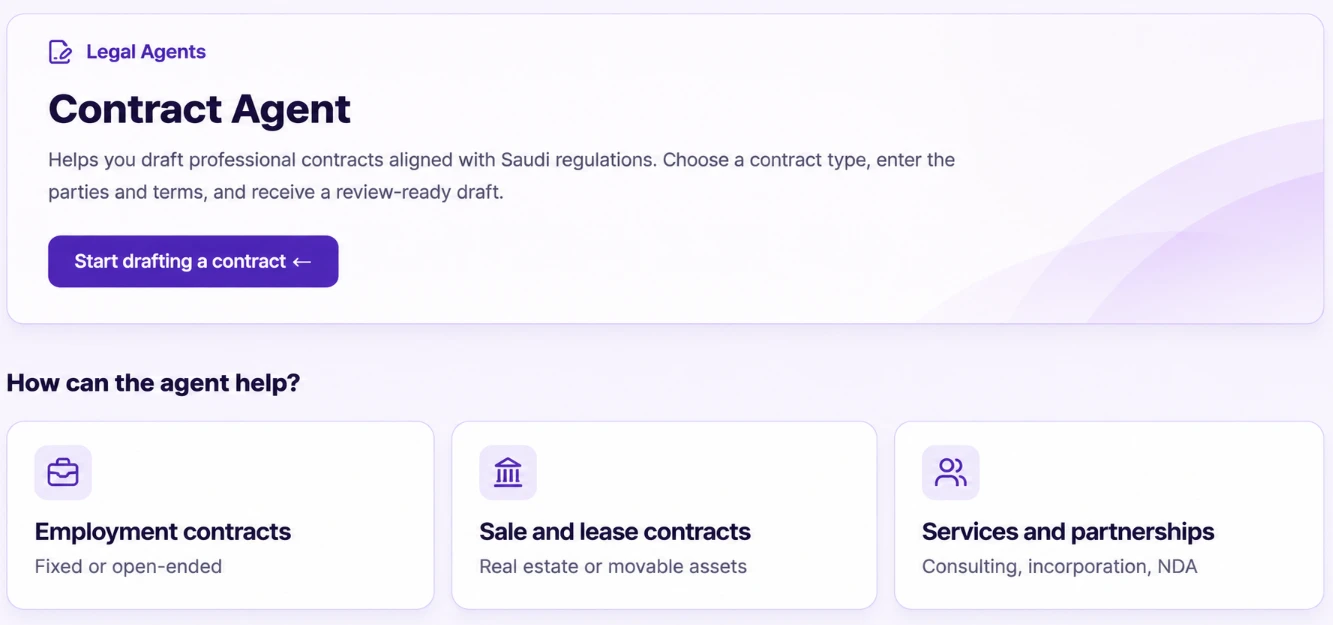
What contracts can the agent help draft?
Employment contracts — the agent can be configured to help draft fixed-term and open-ended employment contracts based on the type of contractual relationship and required data. Information it may need includes: job title, contract duration, compensation, place of work, mutual obligations, benefits, and additional terms. Clauses related to Saudi Labor Law and applicable regulations must be reviewed before any contract is approved.
Sale and lease contracts — the agent can help organize drafts related to the sale or lease of real estate or moveable assets. It assists with arranging party details, describing the subject matter, setting the financial consideration and duration, defining obligations, and outlining termination provisions. Some transactions are subject to specific documentation requirements or procedures that cannot be bypassed.
Service and partnership contracts — the agent can be used to prepare drafts for service agreements, consulting contracts, business partnerships, and non-disclosure agreements. It helps define the scope of work, obligations, financial consideration, confidentiality, liability, and termination mechanism.
How to create a contract agent step by step
Step 1: Choose the contract agent template Start by opening Wkil and selecting the contract drafting agent from the available templates. You can customize its instructions and scope to fit your organization's needs. For example, if your legal department mostly handles service agreements, you can direct the agent to focus on that type.
Step 2: Add regulatory references For the agent to help draft contracts tied to the Saudi legal environment, it needs reliable sources. Provide it with the regulatory texts and regulations relevant to the contract type, along with any templates approved within the organization. Official sources such as the Saudi Legislation Portal, Bureau of Experts at the Council of Ministers are preferable. It is also important to verify the version date of whatever is uploaded, since having a regulation in the knowledge base does not automatically mean it is the latest effective version.
Step 3: Specify the contract type and parties When starting a new contract, the agent should gather the essential information. For a consulting services contract, for instance, it needs to know who provides the service, who receives it, the nature of the service, the agreement duration, and the payment arrangement. If a material piece of information is missing, it is better to ask for it before generating the draft.
Step 4: Enter the core terms After identifying the parties, the agent moves to the contractual terms. These may include the contract duration, financial consideration, obligations of each party, delivery milestones, payment terms, and termination clauses. The agent can organize this information and convert it into written clauses, but it must not invent amounts, obligations, or terms the user has not agreed to.
Step 5: Define additional clauses Contracts vary in their risks and requirements. A services agreement may need a confidentiality clause, while a business partnership may need provisions for managing the relationship. The agent can suggest clauses for consideration, with a clear note that they need to be reviewed.
Step 6: Generate the draft and review it Once the inputs are complete, the agent produces a structured contract draft containing the requested data and clauses. From there, the wording can be reviewed, clauses adjusted, missing terms added, and regulatory texts verified. The contract must not be signed or used officially before it has been reviewed by a qualified legal professional.
Practical example: drafting an employment contract
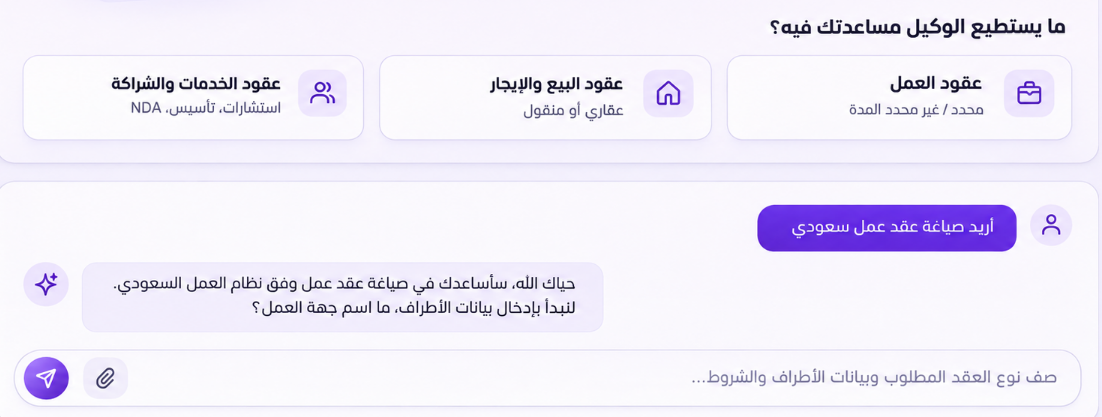
Say a company in Riyadh wants to draft an employment contract for a legal consultant. It enters the following into the agent: document type (employment contract), position (legal consultant), contract duration (one year), place of work (Riyadh), compensation, benefits, and any special terms per the company's data.
After the information is complete, the agent produces an initial draft containing party details, the nature of the work, duration, obligations, compensation, and other relevant provisions, ready for review and editing.
How to build a legal memos agent
What is a legal memos agent?
A legal memos agent is a specialized digital agent that helps prepare legal and judicial memo drafts based on case data, documents, and requests. It can help organize facts, arrange arguments and defenses, draft headings, and produce a draft ready for review and editing.
This differs from contract preparation. A legal memo relates to an existing dispute or judicial proceeding and may be subject to specific procedural deadlines and requirements. The agent therefore needs more precise constraints around factual accuracy, citation of references, and not fabricating information or evidence.
What types of memos can it help prepare?
Defense memos — the agent can be used to help draft defense memos in civil, commercial, and labor cases. It helps arrange the facts, defenses, documents, and requests in organized language.
Reply memos — when a user needs to respond to a claim or memo submitted by the other party, the agent can help identify points requiring a response and organize those responses. These replies must be grounded in the facts and documents provided, not in assumptions the agent generates.
Appeal memos — the agent can be configured to help draft an appeal memo after the judgment, documents, and objections are submitted. Here, the importance of verifying the deadlines, procedures, and specific requirements for the appeal channel is especially clear.
How to build a legal memos agent step by step
Step 1: Choose the memos agent template Start by selecting the legal memos agent in Wkil and defining the required scope clearly — for example, drafting defense and reply memos in commercial or labor cases. You can customize the instructions so the agent follows a specific memo structure and a formal legal drafting style.
Step 2: Add approved legal references The agent needs reliable legal sources. Official sources include the Saudi Legislation Portal, the Saudi Ministry of Justice, and the Najiz Portal for verifying active texts. It is important that the agent's instructions prohibit fabricating statutory materials, rulings, precedents, or citations attributed to non-existent sources.
Step 3: Specify the memo type Before drafting begins, define what document is needed: is it a defense memo, a reply to a claim, or an appeal? This specification helps the agent organize the draft according to the intended purpose.
Step 4: Enter case data The agent needs basic information such as the case number, parties, competent court, and the subject of the claim. This data should be treated as sensitive information, with access restricted according to user permissions and privacy policies.
Step 5: Add facts and documents This is one of the most important stages of memo preparation. Provide the material facts and supporting documents — contracts, correspondence, claims. The agent can organize events chronologically and summarize documents, but it must distinguish between established facts, party allegations, and conclusions that need verification.
Step 6: Define the requests and defenses After the facts are organized, the agent needs to know the requests the memo's presenter wants to advance. The agent helps arrange the arguments and defenses based on the information provided, while flagging points that need support or a reference. It must not choose a litigation strategy or determine final legal rights without qualified oversight.
Step 7: Generate the draft and review it Once the data is complete, the agent prepares a draft containing an introduction, case details, facts, defenses, and requests. The draft is then reviewed to verify the accuracy of names, dates, facts, and references. The format and procedures must be confirmed as compliant with the requirements of the competent judicial authority before filing.
Can the legal memos agent file the document with the court?
Preparing a memo draft is not the same as officially filing it with the court. In Saudi Arabia, electronic judicial services are available through Najiz for filing memos, but using them requires meeting the applicable procedures, conditions, and authorizations. Drafting a memo as a task the agent assists with, and officially submitting it as a judicial act that requires independent verification, must therefore remain separate.
How to make legal agents more accurate and reliable
1. Use reliable regulatory sources — the agent must rely on clear references that can be consulted and verified. Uploading an outdated document and assuming all its provisions are still in force is not sufficient.
2. Do not allow fabrication of texts or rulings — one of the most dangerous potential errors is citing a statutory text or ruling that does not exist. The agent's instructions should require it to show the source of a citation and not assert the accuracy of any material or ruling that has not been verified.
3. Separate drafting from approval — the agent can prepare a draft and help edit it, but final review and approval must remain the responsibility of the authorized person. This applies to contracts before signing and memos before submission.
4. Protect client and case data — contracts and memos may contain confidential information and personal data. Access permissions must be set, documents protected, and a data retention policy defined.
5. Test the agent before using it — start with example cases that contain no sensitive data, and test how the agent handles missing information, conflicting clauses, and unavailable references.
When to use the contract agent and when to use the memos agent
If you work in human resources and need to prepare recurring employment contract drafts, the contract agent is the right choice. If you manage business relationships and need to prepare service and partnership agreements, the same agent can help organize those drafts.
If you are a lawyer or legal consultant who needs to organize case facts and draft memos and replies, the legal memos agent is better suited to the nature of the task.
Legal departments may benefit from using both agents together — with separate access permissions, documents, and tasks — so each agent handles its own specialized scope.
Frequently asked questions about building legal agents
Summary: start with a legal agent focused on one clear task
Building a successful legal agent does not start with trying to make it know all regulations and cases. It starts with identifying the task you want it to help perform.
If your goal is preparing contractual documents, start with the contract agent and define the contract types, references, and approved templates. If your goal is organizing case facts and drafting memos, start with the legal memos agent and configure the knowledge sources, drafting rules, and citation verification.
In both cases, outputs must be treated as drafts that need review and approval before official use.
Through Wkil, you can explore specialized templates and build agents that help your legal department organize recurring work and prepare documents to fit its needs.
---
*Disclaimer: This content is educational and does not constitute legal advice or a guarantee of the validity of any contract or memo. Legal documents must be reviewed by a qualified professional before they are approved or submitted to official authorities.*