

Table of contents
Many companies today are looking for a practical way to speed up recruiting without adding more load on the HR team. This is where an HR agent comes in as a smart solution that handles repetitive tasks, organizes the stages of hiring, and improves the speed of decision-making.
An HR agent is not just a chatbot that answers questions. It is a digital agent that can support your team in real work such as writing job descriptions, receiving resumes, screening applicants, comparing candidates against the role, communicating with them, scheduling interviews, and preparing interview questions tailored to each position.
In this practical guide, we walk through how to build an HR agent step by step, the tasks it can handle inside your company, and how it helps you speed up the hiring cycle and raise the quality of shortlisting. If you want to extend the idea into a full team of agents across the HR department, see /en/agent-teams_hr.
What is an HR agent?
An HR agent is a digital agent designed to support HR and recruiting operations inside the company. It can be configured to follow your policies, your templates, and your approved workflow, so it becomes an operational assistant for the HR team's day-to-day tasks.
Instead of starting manually every time a new vacancy opens, the agent helps you turn the process into an organized flow that starts with the hiring request and ends with a decision and communication with candidates.
What does an HR agent actually do?
An HR agent can contribute to a wide range of tasks, most notably:
Writing the job description
The agent helps prepare a clear, professional job description based on the job title, department, seniority level, and required duties. It can also suggest:
- A role summary
- Key responsibilities
- Required qualifications
- Core skills
- Work location and employment type
- Suitable wording for the job posting
This cuts down preparation time and ensures more consistency across job postings.
Posting jobs and receiving resumes
Once the job description is ready, the agent can support the posting stage and receive applications from different channels, then organize the incoming data and gather it in one place to start screening and review.
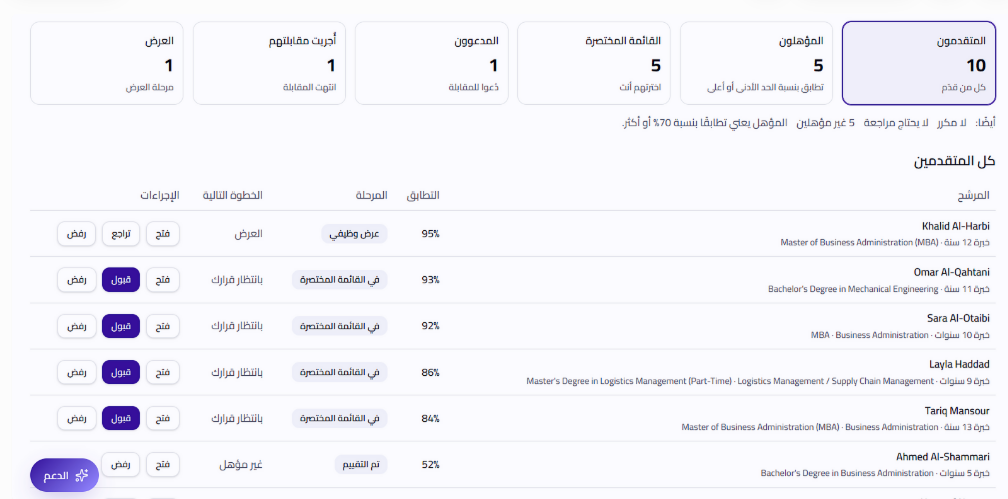
Screening candidates and comparing them to the role
One of the most important roles of an HR agent is reading applicant data, comparing it against the job's requirements, and ranking candidates by match score. This helps:
- Reduce the time spent on initial review
- Surface the candidates closest to the vacancy
- Quickly flag unqualified applicants
- Build a shortlist of the best candidates
Building the shortlist
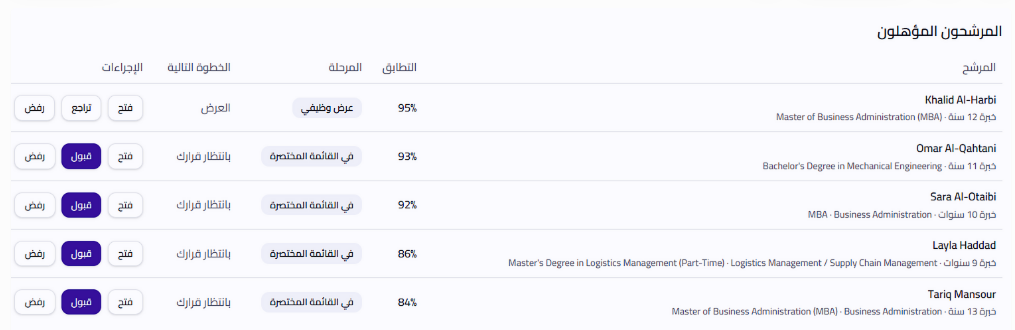
After screening, the agent can help build a shortlist of candidates who pass the required match threshold, showing useful indicators such as:
- Match percentage
- Years of experience
- Educational qualification
- Current stage
- Suggested next action
Communicating with candidates
The agent can be configured to communicate with candidates in a professional, organized way, such as:
- Confirming receipt of an application
- Sending status updates
- Requesting additional information
- Interview invitations
- Follow-up messages
- Rejection or decline messages
This helps raise the quality of the candidate experience and improves the company's image among applicants.
Coordinating and scheduling interviews
The agent helps organize interviews by tracking proposed times, coordinating schedules, and preparing the next steps. It can also reduce the operational chaos that usually comes from manual back-and-forth messages between the hiring team and candidates.
Preparing tailored interview questions
Another important practical use case is that the agent can prepare interview questions tailored to the role, seniority level, and required experience. For example:
- Technical skill assessment questions
- Behavioral questions
- Situational/practical questions
- Questions that measure fit with the nature of the role
This makes interviews more structured and more closely tied to the job's actual requirements.
How to build an HR agent step by step
What is the practical benefit for companies?
Building an HR agent delivers a clear set of benefits, including:
- Speeding up the hiring cycle
- Reducing time wasted on manual work
- Improving the quality of initial screening
- Standardizing job description wording
- Increasing the speed of communication with candidates
- Organizing interview stages
- Improving the candidate experience
- Freeing the HR team to focus on decisions rather than repetitive tasks
When does a company need an HR agent?
An HR agent is especially useful when:
- You have a recurring number of open positions
- Screening resumes takes a long time
- Communication with candidates is slow
- There's no clear mechanism for managing hiring stages
- The team needs to move faster without expanding headcount internally
A practical example of the agent at work
When a new position opens, the HR agent can start by writing the job description, then help publish it. After applications come in, it screens candidates and ranks them by match, builds a shortlist, helps communicate with suitable candidates, prepares interview questions, and tracks the next stage for each applicant.
This way, the agent becomes a real part of the hiring journey, not just a side tool.
Why this matters today
With the growing volume of job applications and expectations of speed in hiring, it has become harder to rely on manual processes alone. Companies today need practical tools that help them stay organized, fast, and accurate — and this is where the HR agent comes in as a smart, applicable option.
If you're looking for a practical way to improve recruiting inside your company, building an HR agent is a strong, direct step. It helps you write the job description, screen candidates, receive resumes, compare applicants, communicate with them, schedule interviews, and prepare tailored interview questions — making the hiring process faster, more organized, and clearer. On the Wkil platform, you can design practical agents that fit your company's needs and support the real workflow across different departments.
Frequently asked questions
Want to build an HR agent that fits how your company works?
Start with the Wkil platform and design your agent to support hiring, from writing the job description to scheduling interviews.